Every compliance training calendar I've ever seen has the same quality: it only adds more training. Somewhere on it is a course nobody remembers choosing, still going out to all employees every year. Retiring it would take a decision, and nobody's been bold enough to retire the last CECO’s course.
It only adds because of the questions we ask when we’re preparing our training plan. Is the training done? Content written, LMS loaded, reminders scheduled. And later, did all employees complete it? Both are questions about finishing. Neither tells us whether the course does the organization any good, or whether it’s relevant to the people taking it.
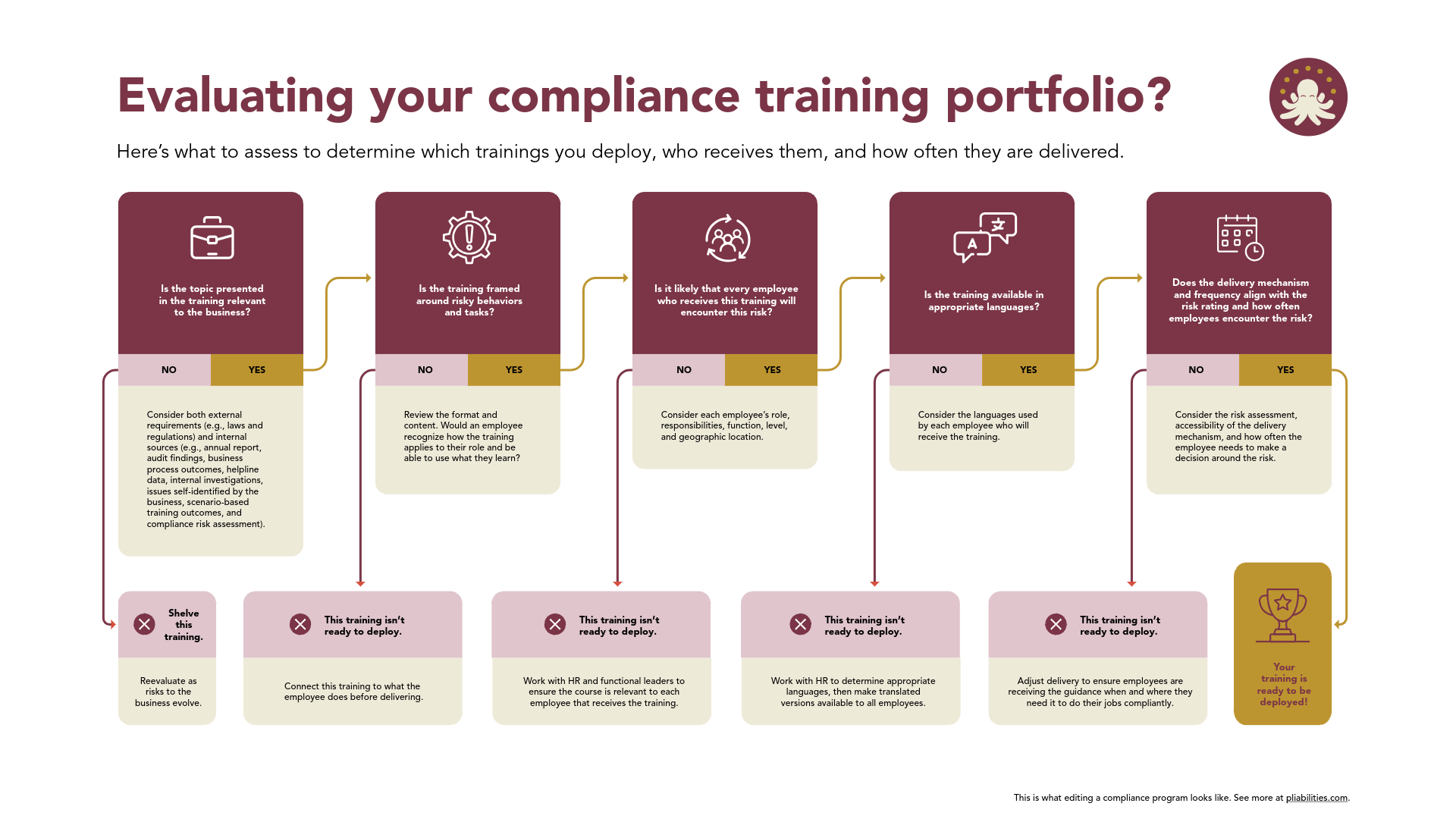
Asking “is this training ready?” is an entirely different question. Practically, it’s five separate questions—and I’m sharing a tool that helps you think through whether a course is relevant, timely, and worth your employees’ time. Answering them honestly means editing your training content and calendar.
How to use this tool
The questions below are the high-level version. The tool itself goes deeper. Get it here.
Start with the first question and run one course through all five. At each step, make the call: does this training match the risk? In other words, does your business carry the risk, do the people taking the course face it, and does it come up as often as you train on it? Keep asking until there’s nothing left to cut.
Most of the answers point toward less, because most programs carry more training than they have risk. That excess becomes its own risk. Every irrelevant course teaches employees that compliance training is something to be clicked through instead of thought through.
Does this risk even belong to your business?
A well-built course on a risk your business barely carries, or doesn't at all, is still a course you shouldn't deploy. Shelve it. Low risk doesn’t mean no guidance. It means no course. Revaluate.
This is the cut people skip, because it's the only one that requires admitting a whole thing was unnecessary. It's easier to keep deploying a course than to stand behind the sentence “we don't need this.” But shelving isn't permanent. The course is ready to come back the day the risk grows.
Would an employee recognize themselves in it?
Training fails when the humans can't see the HUMANS. (Need more on HUMANS? Go follow Christian Hunt.) Training framed around a policy instead of an everyday behavior will certify completion and change nothing. The employee finishes it, learns that a rule exists, and has no idea what it asks them to do differently.
Here, what you cut is the abstraction. Somewhere inside a generic course about “conflicts of interest” is a specific decision a specific person makes—the vendor who's also a cousin, the gold watch gifted during the holidays, the board seat at a competitor's company. The finished, generic version isn't ready. The version built around the decision is the one you deploy.
Does everyone actually need this training?
Now the question moves from whether to who.
A company-relevant course, well built, delivered to 3,000 people when only 400 of them will ever encounter the risk, is not risk management. It's noise with a completion rate. And every hour those 2,600 people spend on a risk they'll likely never touch is an hour they didn't spend on one they will.
The question asks you to look at role, function, level, and geography, and to accept that “mandatory for everyone” is a decision you have to earn, not a default you inherit. That’s hard for us. We’re risk-averse by trade, and leaving someone out feels like leaving a gap, because what if they need this training one day? So the reflex is everything, to everyone, every year. Three of these questions exist to help you break that reflex, one piece at a time. This is the second.
Can the people who face the risk actually take it in?
A relevant course, well built and correctly scoped, still isn't ready if the people who face the risk can't take it in. Sometimes that’s the wrong language. Sometimes it’s a reading level written for lawyers. Sometimes it’s a format that doesn’t work with a screen reader, or a video with no captions. The training gets deployed and the completion gets recorded, but the guidance never reaches them, and behavior doesn’t change.
This is the one question that can add work, but it’s worth it. Work with HR to identify the languages your people use and the accommodations they need. Then translate, simplify, and fix the format. The course and scope stay the same. Now it can do its job.
How often does this training need to run?
The last question is cadence, and it's where the most waste sits.
“Annual” is not a frequency. It's a habit. Some risks live in a decision an employee makes 40 times a day, and those don't want a course every January—they want guidance in the flow of work, at the moment the decision arrives. Other risks come up once in a career. A once-in-a-career risk does not need a yearly reminder. It needs to be findable the day it surfaces, and the employee needs to recognize that day when it comes.
Matching delivery to how often the decision comes up is the last cut. It's usually the easiest one to defend, because by the time you reach it you've already made the four harder calls above it.
Compliance training with a reason
Run one course through these questions and you've made a launch decision. Run your whole training portfolio through them and you've done something else. You've found the courses that should be shelved, the generic ones that need rebuilding around a real decision, the audiences that were never at risk, the training people couldn’t understand and apply in real life, and the annual habits that outlived their reason. Congratulate yourself. You've built the one thing a compliance program almost never has: a defensible answer to why do we do it this way?
Which raises the question most training calendars are built to avoid: is this course ready?
This is what editing a compliance program looks like. The tool is here and there's more at pliabilities.com.