Using AI with intention
Originally posted on LinkedIn on February 5, 2026
One fun fact about me: I don’t love trends.
Not in a grumpy way. In a protect-my-attention way.
When something is suddenly everywhere—books, movies, platforms, frameworks, “must-have” tools—I usually wait. I want to see what lasts. I want to hear what people really think after the excitement fades.
Are they popular because they’re truly great—or because everyone else says they are?
I'm the one who could be described as "late to the party," but I’m just careful about what I give my time to.
To be clear, I love pushing boundaries and exploring new tools. I just like to understand the value first and let the early chaos settle before I commit.
AI was one of those things. I watched it explode. I listened. I waited. And then—quietly, thoughtfully—I started using it.
What AI changed (and what it didn’t)
Let’s get this part out of the way:
AI is not replacing my brain.
It is not doing my job for me.
It is not making decisions on my behalf.
What it has done is give me more capacity than I’ve ever had before. Not because I suddenly became more strategic or more insightful, but because more of my time gets to live where I already work best.
AI doesn’t give me new skills. It protects the ones I already use every day. Because here’s the part no one puts on the slide:
AI reflects the clarity you bring to it. When the input is vague, the output usually is, too.
Writing prompts isn’t magic. It’s not that different from drafting technical instructions or giving clear direction to a direct report. You still have to know what you’re trying to say. You still have to know what “good” looks like.
And, most importantly, you still have to own the result.
Nothing leaves my desk unless it’s been carefully planned, reviewed, revised, and finalized myself.
AI still gets things wrong. Often. That doesn’t make it useless. It just means it can’t be in charge.
A small (and slightly ridiculous) example
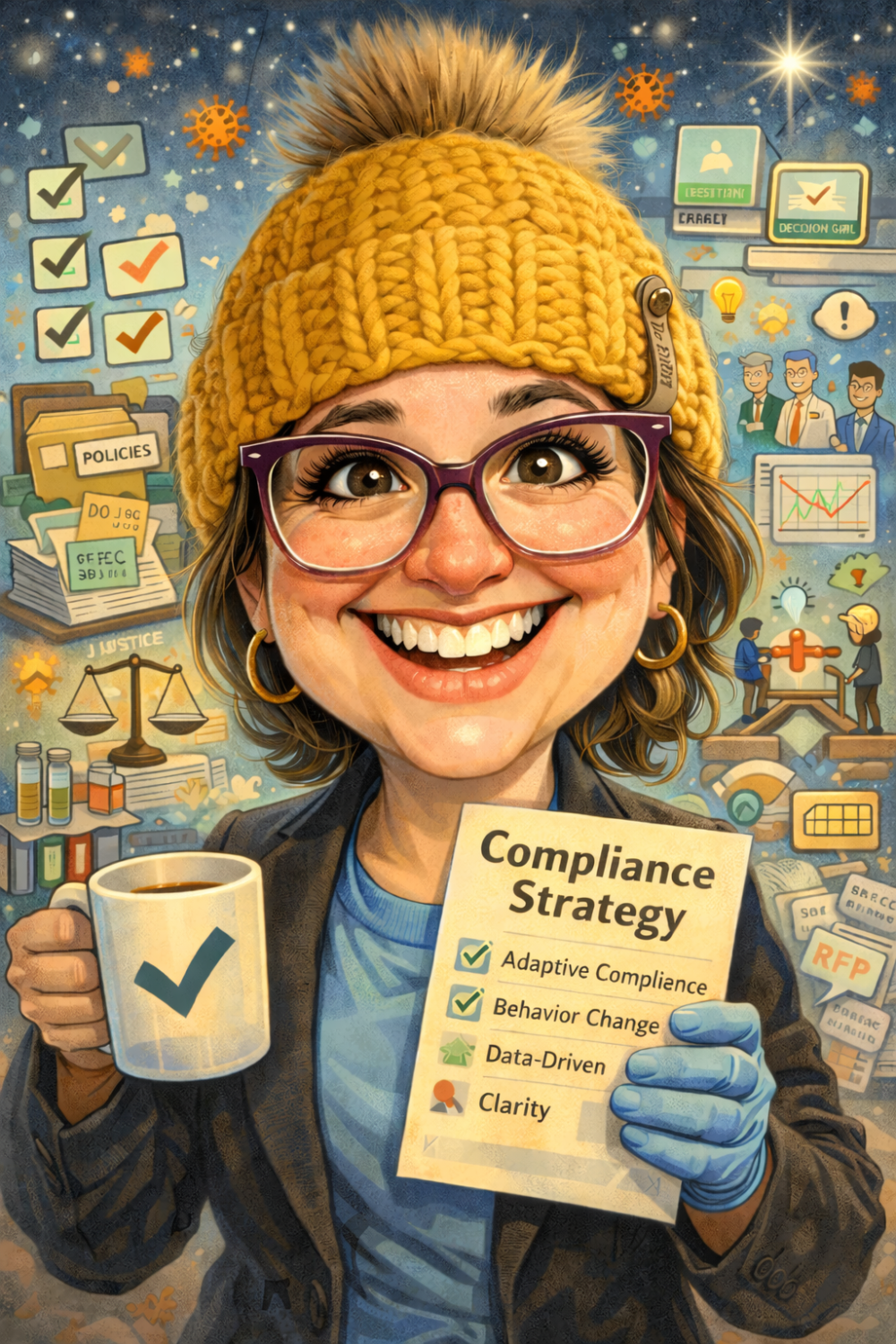
I once asked AI to create a caricature of me based on what it “knew” about me. On its third try, it gave me the most bizarre version of a compliance professional you could imagine.
Manila folders. Checklists. A single latex glove. (A latex glove!?) Nothing about how I actually think. Nothing about how I work. Nothing about what makes me me.
It wasn’t entirely wrong (except for the latex glove) it was just shallow. AI doesn’t know context; it knows patterns. Without human judgment, it defaults to the most obvious version of a role, not the real one.
That’s the risk—not that it replaces us, but that it flattens us if we don’t stay involved.
Where it’s actually helped me
The real shift for me has been in how I work with policies and compliance communications. Not as static documents. But as living systems.
AI has helped me quickly see where policies contradict themselves, surface gaps that are hard to spot when you’ve been staring at the same text for years, and draft and redraft in minutes what used to take hours. Not to replace judgment but to sharpen it.
It helps me move faster while still holding my work to the same standards I’ve always had.
Why I’m talking about this now
Sure, AI is still a buzzword. It’s been labeled onto almost everything—even when no real AI is actually involved.
But I see a real opportunity for ethics and compliance teams who are already doing thoughtful, responsible work to do it with more clarity and less friction.
I’m co-presenting with Taylor Epley, and we’re bringing this conversation to True North on Wednesday, February 11, because we’re both seeing the same thing: People want to use AI responsibly but they don’t want to lose their voice, their judgment, or their standards in the process.
That’s what this session is about. Not tools. Not shortcuts. Not automation promises. Just what it looks like when AI supports human thinking rather than pretending to replace it.
(Also, it’s free to attend and offers 1.2 CCB CEUs.)
There’s no single right way to adopt AI, but we’ll be sharing the ways that have worked for us.
If you’ve been skeptical, overwhelmed, or quietly experimenting in the background, you’re not late. You’re just being intentional and that’s a pretty good place to start.